
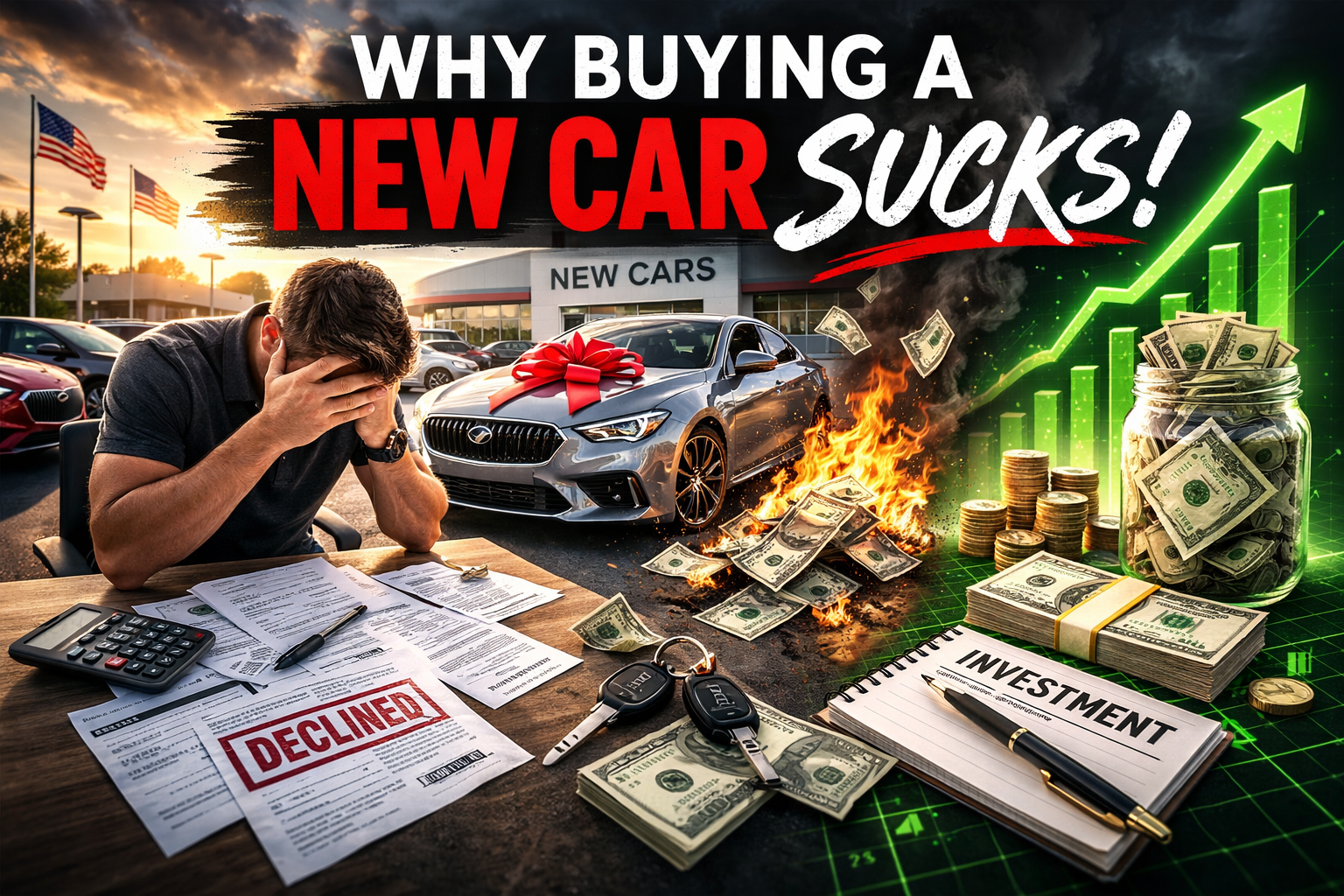
Buying a new car sucks, we’ve all done it.
Stepping onto a new car lot, rows of shiny, spotless vehicles immediately grab your attention. The fancy bells and whistles start to look irresistible. The roar of a V8 in a sports car turns heads. The spacious interior of an SUV or minivan suddenly feels practical and impressive.
Then we sit inside.
That new-car smell hits. It feels fresh. It feels premium. We start picturing our life in it how cool we’ll look, how smooth the commute will feel, how great it’ll be driving the kids around.
Before we know it, our emotions are sky high. We’re invested, we’re rationalizing, and we’re ready to pull the trigger regardless of the financial consequences.
We start telling ourselves:
“I’ve worked hard. I deserve this.”
“We need a bigger car for the kids.”
“My current car doesn’t even have Bluetooth.”
Some of that might be true.
But buying a brand-new car to scratch those itches is one of the fastest ways to wreck your finances.
Here are the reasons why buying a new car sucks.
1. The Instant Depreciation Hit
This is the one lesson I remember most from my parents growing up: the moment you drive a new car off the lot, it loses value.
And they weren’t wrong.
New vehicles commonly lose around 9–11% of their value immediately once titled and driven off the lot per engineerfix.com.
Using a $40,000 car as an example:
A 10% drop means that car is now worth $36,000 the second you leave the dealership.
Why does this happen?
Because it’s no longer classified as “new.” It’s now considered “used.”
You just paid thousands of dollars for a label change.
2. The True Cost Goes Beyond the Sticker Price
The sticker price is just the beginning.
Sales Tax
If you live in a state with sales tax, you’ll pay it on the full purchase price. Where I live, that’s 8.25%.
On a $40,000 car, that’s an additional $3,300.
That’s a serious chunk of money added instantly.
Registration and DMV Fees
The government doesn’t process paperwork and issue plates for free. Fees vary by state and vehicle, but they’re unavoidable.
Dealer Fees and Add-Ons
Dealers love slipping in extras.
I once had a dealership tell me they wouldn’t sell me a truck unless I agreed to a tracker system and paint protection package adding $2,000 to the price.
I walked out.
Many people don’t.
Higher Insurance Costs
While some newer cars have added safety features, upgrading from an older vehicle to a new one often increases insurance premiums.
When I upgraded, my insurance jumped nearly $175 per month.
That’s $2,100 per year just for insurance.
3. Long Term Payment Trap
Car salespeople don’t ask what car you want.
They ask, “What monthly payment are you comfortable with?”
That’s the trap.
Once they know your number, they stretch the loan term to make the payment fit. Say you tell them $300 per month. They’ll extend the loan to 84 months if your credit allows it and suddenly, you’re driving a more expensive car than you planned.
You feel like you “won.”
You didn’t.
Longer terms mean:
- More interest paid
- Slower equity buildup
- Years of financial restriction
Always focus on the out-the-door price not the monthly payment.
5. You Fall Victim to Lifestyle Inflation
New cars fuel lifestyle inflation.
You get promoted, you get the office with windows, and you start wearing suits.
And suddenly you think, “I can’t be seen driving a beater.”
So you buy the BMW.
Now your entire raise is gone.
And what if you hate the job?
Too bad. You’re stuck. That payment isn’t going anywhere.
It rarely stops at the car.
Now you need a garage.
Or you need detailing.
And now you don’t want to park too close to other cars.
Before you know it, you’re more stressed financially than before the promotion.
It’s a vicious cycle and too many people fall into it.
5. Going Upside Down
As mentioned earlier, the car depreciates immediately.
That means you often owe more than it’s worth especially early in the loan.
If life happens and you need to sell it, the lender wants the full principal balance.
If the car doesn’t sell for enough?
You must pay the difference out of pocket.
That’s called being upside down and it’s not a fun place to be.
To Sum It Up Buying a New Car Sucks
At the end of the day, a car is a tool.
Its job is simple: get you from point A to point B safely and reliably.
It is not a status symbol, or a wealth-building asset, nor is it a measure of success.
Buy the cheapest reliable vehicle you can afford ideally with cash.
The money you save and invest instead will grow into something far more powerful than a shiny new car ever could.
Your future self will thank you.