
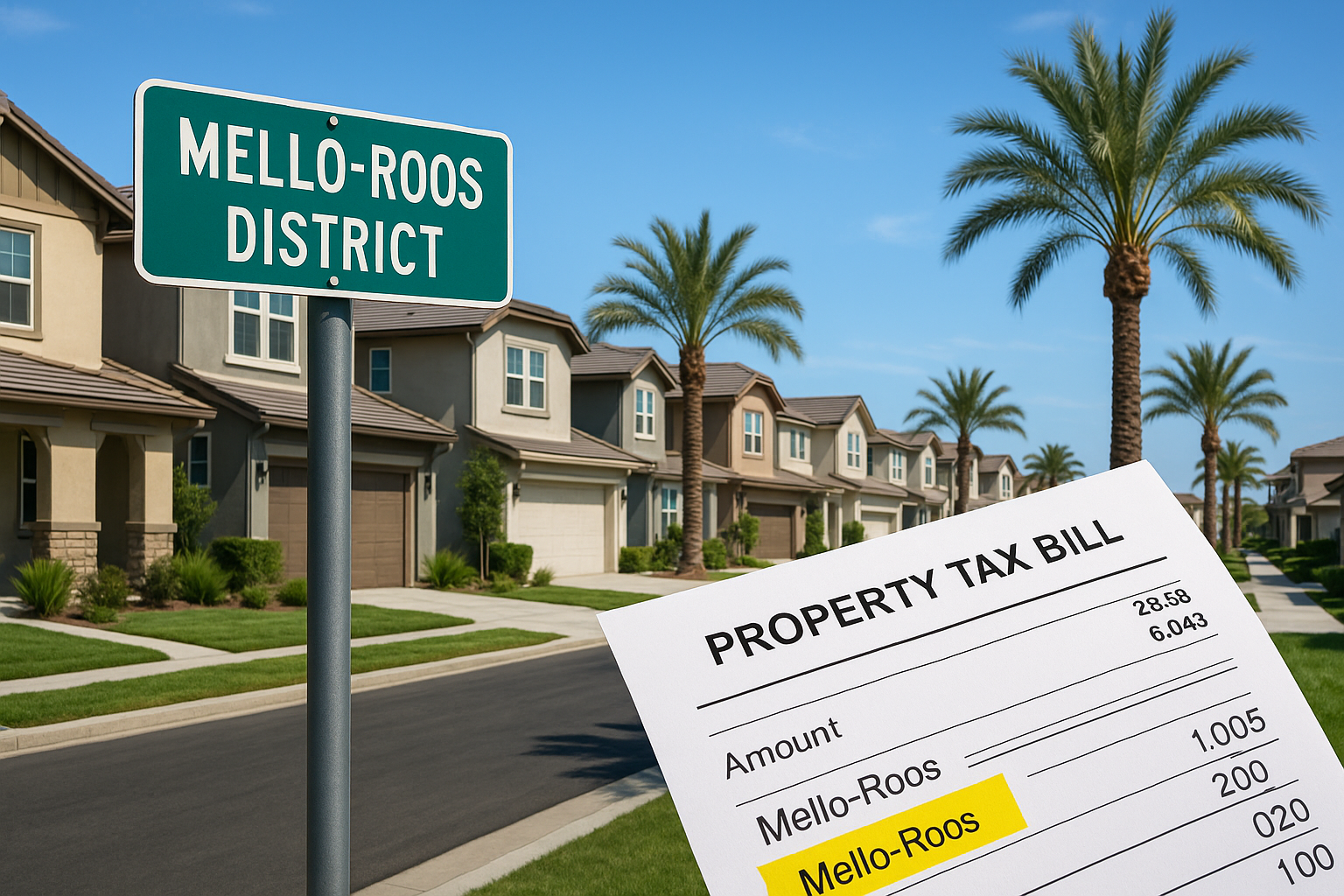
If you’re buying a home in California, you’ve likely come across the term Mello-Roos in property listings or disclosures. These special taxes can significantly impact your monthly housing costs and sometimes come as a surprise for first-time buyers.
In this guide, we’ll break down what Mello-Roos taxes are, why they exist, where you’ll find them, and how they can affect your property taxes and budget. Understanding Mello-Roos is essential if you want to make a smart and informed homebuying decision in California.
What Is Mello-Roos?
Many California cities and counties rely on Mello-Roos taxes because rapid growth often creates a need for new infrastructure funding that standard property taxes can’t fully cover. Local governments also face limits on raising property taxes due to Proposition 13, which caps how much property tax rates can increase each year.
Mello-Roos taxes give cities and counties a way to generate revenue for essential public services and community improvements without raising base property tax rates for all residents. The funds often pay for new schools, roads, parks, water systems, electricity infrastructure, and sewage lines in developing areas.
Now if your like me and live in a new community in California that has a Mello-Roos assessment. You most likely are seeing and using critical infrastructure daily that the Mello-Roos is paying for. In my case my this is paying for the construction of the roads I drive on around my house, water connections to supply me with water to use throughout my house, electricity lines I use to power all my electronics, and sewage systems to remove household waste. Without Mello-Roos funding, I wouldn’t have the necessary infrastructure to live at my current residence, in fact it would probably still be a field full of weeds without this funding.
Where You’ll Find Mello-Roos
Mello-Roos taxes are most common in:
- Newer developments or planned communities
- Areas experiencing rapid growth
- Regions like Southern California, parts of the Central Valley, and the Bay Area suburbs
Before buying, it’s wise to check if a home is in a Mello-Roos Community Facilities District (CFD). In some cities, large percentages of newer homes carry these special taxes.
How Mello-Roos Affects Your Property Taxes
One of the biggest surprises for California homebuyers is how much Mello-Roos taxes can add to your overall property tax bill each year. Unlike your mortgage’s principal and interest payments, Mello-Roos is usually included in your annual property tax statement as a separate line item, making it easy to overlook during the homebuying process. To provide a real-world example, in my wife and I case we pay $212 per month or $2,544 dollars per year in Mello-Roos.
Some key points:
- Billed separately: Mello-Roos charges appear as their own item on your property tax bill, separate from base taxes and other assessments.
- Lasts for decades: Many Mello-Roos districts have tax terms lasting 20–40 years, depending on how long it takes to pay off the bonds that funded community improvements.
- Not always deductible: Whether Mello-Roos taxes are deductible on your federal income tax return can vary. Some portions might be deductible as property taxes, while others might not be. Always check with a tax professional for your specific situation.
How to Find Out If a Property Has Mello-Roos
Wondering whether a home you’re eyeing has a Mello-Roos tax? Here’s how to check:
- Review the property’s tax bill. Mello-Roos taxes often appear as separate line items.
- Ask your real estate agent. Knowledgeable agents can confirm whether a neighborhood has Mello-Roos assessments.
- Ask the developer. If your buying a new build home in a subdivision ask the agent sitting in the model homes, they will know.
- Check the seller’s disclosure documents. California law requires sellers to disclose special taxes like Mello-Roos.
- Contact the county tax assessor. They can provide details about tax rates and the duration of the assessment.
Knowing upfront helps you avoid surprises in your monthly housing costs.
Pros and Cons of Mello-Roos
Is Mello-Roos all bad news? Not necessarily. There are pros and cons you should weigh before buying in a Mello-Roos district.
✅ Pros of Mello-Roos:
- Funding for new schools, parks, roads, and public services
- Often results in better infrastructure and amenities than in older areas
- Helps maintain higher property values in newer communities
❌ Cons of Mello-Roos:
- Higher annual costs, adding significantly to your property taxes
- Possible impact on resale value some buyers shy away from homes with special taxes
- Payments may last 20–40 years, even if you sell sooner
Can You Avoid or Remove this Special Tax?
Unfortunately, you can’t simply opt out of paying Mello-Roos taxes if you buy a home in a Community Facilities District (CFD). Once you own property in a Mello-Roos district, you’re obligated to pay the tax until the bonds are paid off. The only real way to avoid Mello-Roos altogether is to buy in an area that doesn’t have these special taxes, or to move to a neighborhood where the Mello-Roos bonds have already been paid off. If avoiding this cost is a priority, be sure to check property tax records and disclosures before buying.
However:
- Some CFDs allow early payoff of the remaining bond balance. This can eliminate future annual payments but requires a significant upfront cost.
- Mello-Roos taxes eventually expire once the bonds that funded community improvements are fully paid often after 20 to 40 years.
If you’re considering buying in a Mello-Roos district, be sure to ask:
- How many years remain on the bond?
- Is early payoff an option, and how much would it cost?
Tips for Homebuyers
If you’re buying a home in California, follow these tips to handle Mello-Roos smartly:
- Calculate total monthly costs. when budgeting be sure include Mello-Roos in your estimated mortgage payment and escrow.
- Compare homes with and without Mello-Roos. Weigh the benefits of newer amenities against the extra cost.
- Ask for documentation. Get copies of tax bills and CFD information before closing.
- Think long-term. Consider how Mello-Roos could affect resale value or your budget years from now.
Final Thoughts
Mello-Roos taxes are an important piece of the homeownership puzzle in California. They can mean better schools, roads, and community amenities but also higher yearly costs.
Before you buy, take the time to understand whether a property carries Mello-Roos, how much it will cost, and how long it will last. With careful planning, you can decide if the benefits outweigh the extra expense and avoid costly surprises down the road.