
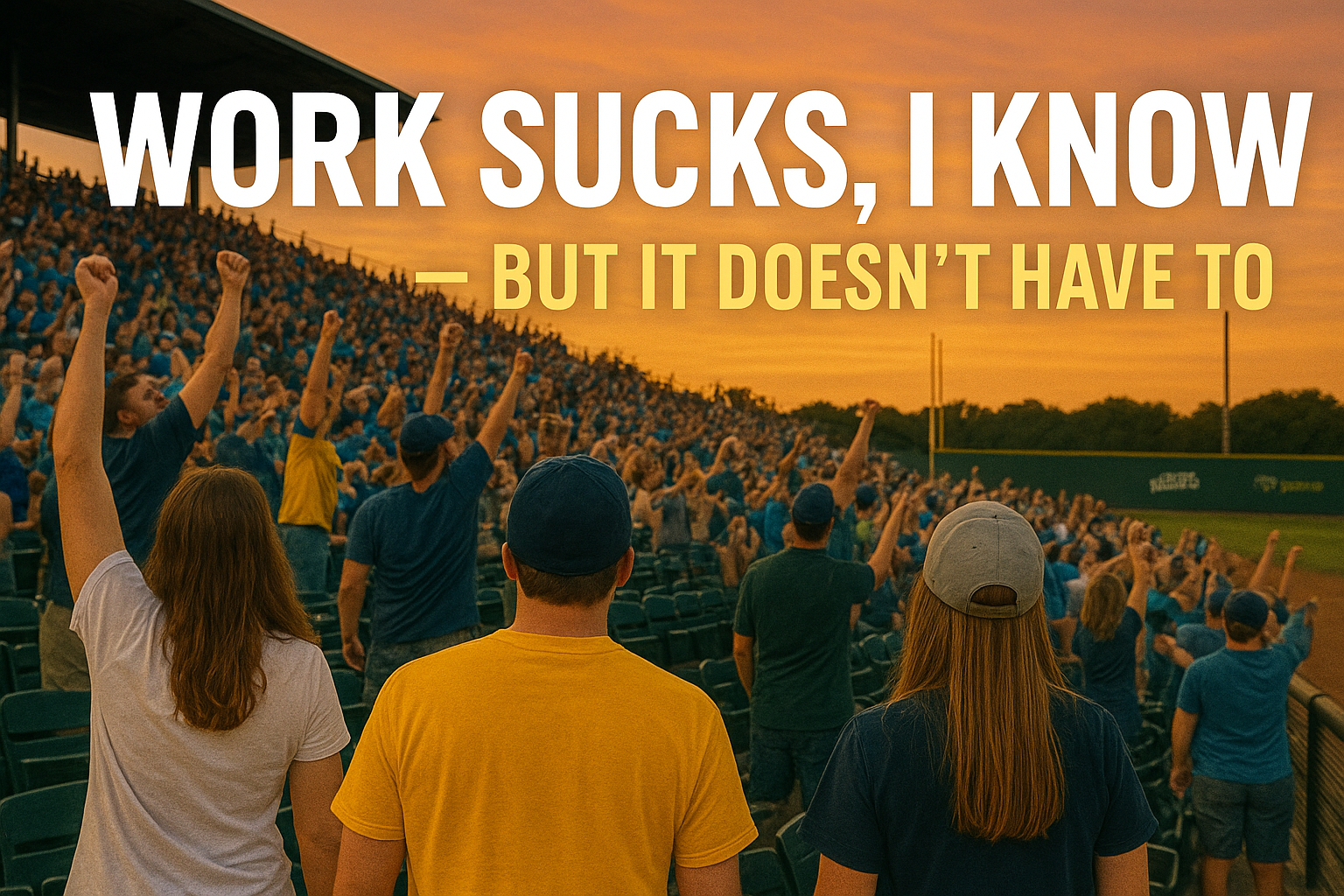
A month ago, I went to a Savannah Bananas game with family and if you’ve never been, let me tell you, it’s not your average baseball experience.
You walk in expecting a game, and instead, you get a show. The players are dancing. The umpires are moonwalking. The mascot’s tossing bananas into the crowd. It’s part circus, part comedy act, part sports and 100% joy.
The energy is contagious. You can’t help but laugh, sing, and just be there.
But somewhere between the third and fourth inning, something happened that turned that fun moment into something surprisingly profound.
The speakers blasted Blink-182’s “All the Small Things.”
And if you know the song, you know what’s coming.
🎶 Work sucks, I know! 🎶
The entire stadium from the dugouts to the nosebleeds shouted those words in perfect unison. Thousands of voices. One shared emotion.
And I stood there, smiling, thinking: Wow. That’s the most honest lyric ever written.
Because it’s true work does suck sometimes.
But it doesn’t have to.
And that’s when it clicked this wasn’t just a fun crowd moment. It was a snapshot of why we chase financial freedom in the first place.
Why “Work Sucks” Resonates So Deeply
When Blink-182 dropped that line back in 1999, it became an anthem for a generation. It wasn’t deep or poetic. It was just real.
Everyone has had that Monday morning where your alarm hits, your coffee’s cold, and you’re already behind before the day even begins.
We don’t hate working. We hate feeling stuck.
We hate having no say in how we spend our time. We hate trading our best energy for just enough money to make it to the next paycheck.
That’s the part that sucks.
And deep down, most of us know it. That’s why a whole stadium can scream those lyrics and instantly understand each other.
But what if we didn’t have to live like that forever?
That’s what financial freedom offers not the dream of never working again, but the ability to choose when, where, and how you do it.
The Hidden Cost of “Work Sucks”
We joke about it a lot. The memes, the tweets, the coffee mugs that say “Is it Friday yet?” But the truth is, living in that constant cycle of burnout and frustration comes with a price.
When you feel trapped by work, it doesn’t just affect your job. It leaks into everything else.
You’re too drained to enjoy your evenings.
You’re too tired to be present with your family.
You’re too anxious to plan for the future.
It becomes a loop:
Work hard → Spend to escape → Need to work harder to keep up.
And the cruel part is, it feels normal because it’s what most people around us are doing too.
That’s why moments like that Blink-182 singalong hit so hard. It’s a collective sigh — a little bit of rebellion and a little bit of truth.
We all want out of the cycle.
Financial Freedom Is the Exit Ramp
Here’s the thing: financial freedom doesn’t happen overnight.
It’s not a lottery ticket. It’s a series of small, consistent, intentional moves that compound over time.
But every one of those steps is a brick in the wall between you and the “work sucks” version of your life.
Here’s what it looks like in practice:
1. Define What Freedom Means for You
Financial freedom doesn’t have to mean early retirement. For some, it’s quitting the 9-to-5 and starting a business. For others, it’s being able to take a month off without worrying.
Maybe it’s having enough saved that you can turn down toxic work. Maybe it’s simply not living paycheck to paycheck.
Freedom is personal. But you can’t build toward it if you don’t define it.
2. Build a Cushion — Even a Small One
The first real taste of freedom often comes from your emergency fund.
That small pile of cash sitting in your savings account may not feel exciting, but it’s power. It’s the power to say, “I don’t have to panic if my car breaks down.”
Or, “I don’t have to take that overtime shift just to survive.”
Every dollar you save buys you a little more peace of mind and that’s worth more than any fancy purchase.
3. Invest Automatically and Let Time Do the Work
Once your basics are covered, automation is your best friend.
Set up recurring transfers to your 401(k), IRA, or brokerage account. Treat it like a bill you owe your future self.
The beauty of investing isn’t about timing the market it’s about time in the market.
You don’t need to be a genius to grow wealth. You just need to be consistent.
4. Simplify Your Lifestyle
The Savannah Bananas game reminded me of something: joy doesn’t require luxury. People were having the time of their lives in bleachers with $6 hot dogs.
Freedom often comes from less, not more.
When you keep your lifestyle below your income, you create a gap and that gap is where freedom grows.
Every dollar you don’t spend is a dollar that keeps working for you.
5. Create Flexible Income Streams
One of the best ways to stop feeling trapped is to diversify how you make money.
It could be freelancing, digital products, rental properties, or online businesses. You don’t need to build an empire just something that gives you options.
Because when your paycheck isn’t your only source of income, your employer stops owning your peace of mind.
From the Stadium to Real Life
That night, as the crowd kept singing and laughing, I looked around and thought this is what we’re all chasing.
Not wealth for the sake of wealth. Not early retirement out of boredom. But freedom.
Freedom to enjoy life without guilt.
Freedom to spend time how we want.
Freedom to dance, sing, and laugh in the middle of a baseball game without thinking about the next work email.
And here’s the wild part: the joy in that stadium didn’t come from money.
It came from community, from letting go, from being present.
That’s what financial freedom ultimately gives us the mental space to live like that more often.
The Blink-182 Philosophy of Freedom
Blink-182 never set out to be financial philosophers, but they accidentally nailed it.
“Work sucks, I know” isn’t just a line it’s a wake-up call.
We’re not meant to just survive the week and start over.
We’re meant to build lives that align with our values, not just our paychecks.
That doesn’t mean quitting your job tomorrow. It means playing the long game.
Every decision you make to save, invest, or simplify is you turning down the volume on “work sucks” and turning up the sound on your freedom playlist.
The Takeaway
As the game ended and we walked out into the warm Savannah night, I kept humming that line under my breath.
“Work sucks, I know.”
Yeah, it does for now.
But it doesn’t have to forever.
Financial freedom isn’t about escaping work entirely. It’s about creating a life where you no longer feel trapped by it.
It’s about waking up and realizing you get to choose what “work” means to you.
That’s the real goal not millions in the bank, but control over your time, your choices, and your peace.
So next time that song comes on whether you’re in traffic, at your desk, or in a baseball stadium full of strangers sing it loud.
Then remember: you’re not just singing about frustration.
You’re singing about your motivation.
Freedom’s waiting.
And every smart money move you make brings it a little closer.