
The biggest question some of us will ask, while others will answer.
It’s a simple question, but it will forever change the trajectory of your life.
But getting to this question is no easy feat. The process is long and filled with countless first dates, failed relationships, getting to know your partner, and the ever-so-scary process of engagement ring shopping.
There are so many different shapes and sizes of diamonds paired with different ring styles, which can vastly change the price of the ring.
And with the cost ranging from a few thousand dollars into the millions, many are left wondering, “How much should I spend on this ring?” That’s where conversations around engagement ring budgets start to take center stage.
While the diamond industry has long stated that you should spend three months’ salary, that slogan seems to benefit sellers more than buyers (if you ask me). The true answer is far more personal than you think.
The “3-Month Salary Rule” – Myth or Reality?
The three-month salary rule actually came from a marketing campaign by De Beers in the 1930s. While I can’t say exactly what their intent was, my theory is they were trying to get the average person to spend a significant amount of money on a ring under the pretense of love.
Being the accountant that I am, I’ll admit, it’s nice to have a rule to follow. But I’ve come to learn that love, engagements, and weddings don’t follow clean rules, especially when it comes to engagement ring budgets.
If we blindly follow this rule, we risk buying something too big or too small depending on our partner’s preferences. I learned this firsthand when I went ring shopping with my wife (girlfriend at the time). She was not impressed by big, flashy rings.
Putting something that large and flashy on her finger actually made her nervous. She didn’t want to walk around feeling like she might attract the wrong kind of attention.
Additionally, she wanted something unique, not the traditional, “tried and true.”
If I had followed that rule, I would have bought something far too big, something she wouldn’t have even felt comfortable wearing.
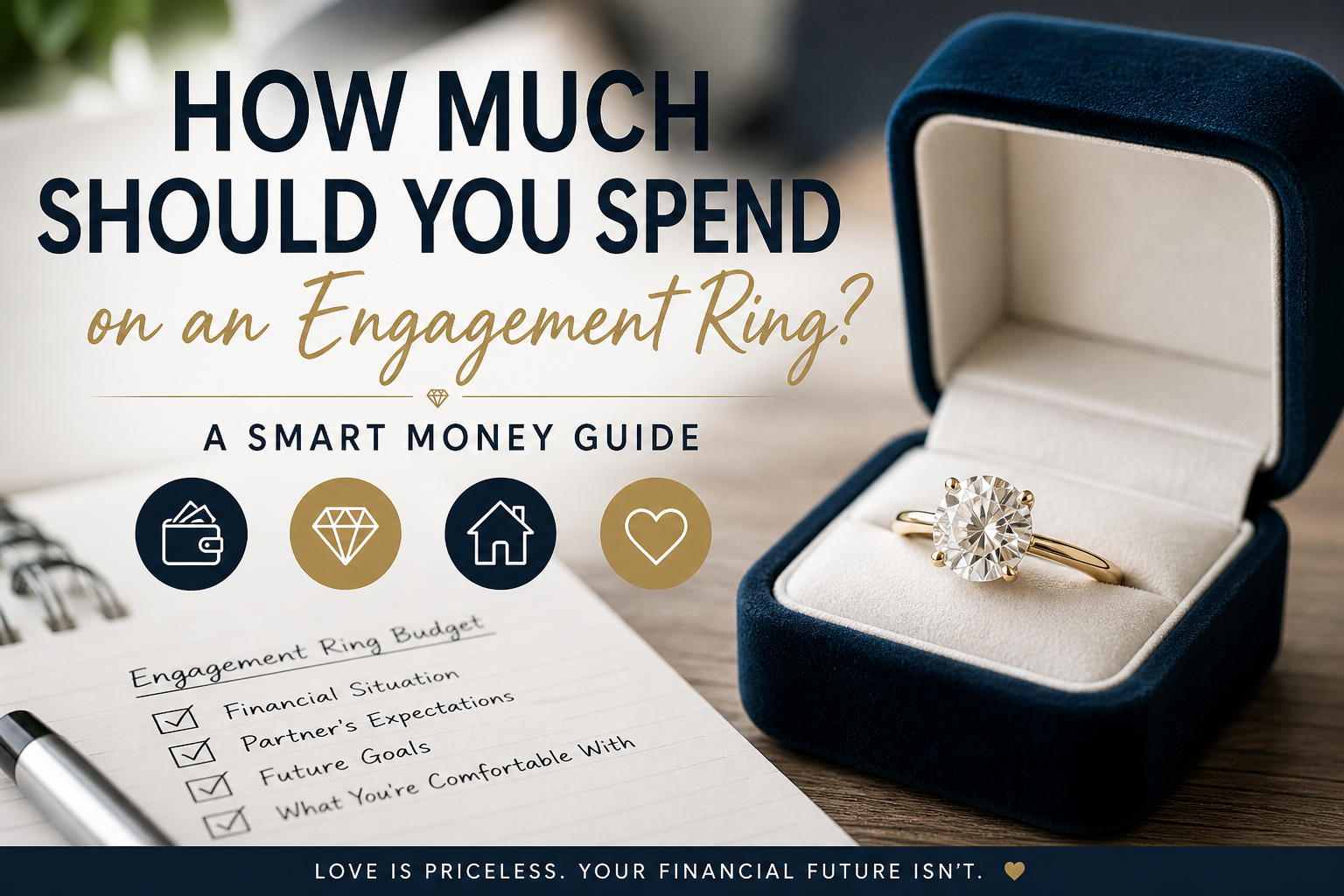
What Really Matters When Setting Your Budget
Your Financial Situation
The first piece is understanding where you stand financially. Know your income, your savings, whether you have debt, if you have a fully funded emergency fund, and what amount you’re actually comfortable spending.
Your number will likely look very different from someone else’s, that’s the reality of personal finance and engagement ring budgets.
Don’t get swept up in what others are spending. Focus on what you can afford.
Your Partner’s Expectations
As I mentioned, my wife didn’t want a ring that screamed “look at me.” She wanted something subtle but different.
She also would’ve been furious if I had taken on debt or spent three months’ salary on a ring.
Our relationship wasn’t built on money or gifts, it was built on connection. The price of a ring was never going to change that.
Your Future Goals
This is a big one.
If your goals include a large wedding, buying a home, or having kids, you need to ask yourself: how much can I spend without delaying those goals?
Maybe you’re planning a smaller wedding and can allocate more toward the ring. Or maybe you’re buying a house soon and need to be more conservative. Either way, your future goals should heavily influence your engagement ring budgets.
A Practical Rule of Thumb
My suggestion? Throw out the salary rule and go into ring shopping with a fixed number in mind.
To determine that number, weigh your financial situation, your partner’s expectations, and your future goals. Then come to a reasonable conclusion.
I will say this, this purchase represents your love. It’s something your partner may wear every day for the rest of their life.
Because of that, you shouldn’t take the absolute cheapest route. But you also should never spend more than you’re comfortable with.
I can’t stress this enough: if you need to finance a ring, it’s probably too much. Either find a more affordable option or save a little longer.
Ways to Save on an Engagement Ring
Today, there are more options than ever, many of which are budget-friendly.
Lab-grown diamonds, for example, have exploded in popularity over the past few years. Many of my friends have chosen them for their partners’ rings.
The best part? They look identical to natural diamonds but cost significantly less.
You can also consider alternative stones. When I was shopping, we came across jewelry that didn’t even use traditional diamonds. One ring had an aquamarine stone and cost around $1,500. While we didn’t choose it, it looked great for the price.
Lastly, consider non-traditional retailers. A coworker of mine bought his wife’s engagement ring online and saved thousands.
He used physical stores to figure out size and preferences, then purchased online once he knew exactly what he wanted. It ended up being perfect.
Real Talk – It’s Not About the Ring
When I was shopping, I thought the ring had to be perfect. That mindset created a ton of pressure.
But the more I shopped and talked with my girlfriend at the time, the more I realized, it was never about the ring.
She would have been happy with anything I chose.
Our relationship wasn’t built on money or material things, and that’s exactly why it’s been so strong.
If you’ve found the right partner, they’ll feel the same way.
Final Takeaway
When buying a ring, it’s not about following some outdated 1930s rule.
It’s about finding something that fits your financial situation, your goals, and your relationship.
Chances are, your partner would rather be in a strong financial position than have a slightly bigger ring.
The ring isn’t for showing off, it’s a symbol of your love and your commitment to each other.