
Government bonds and debt seem to be the big elephant in the room that gets swept under the rug, if you can believe that.
As of May 2026, the federal government has about $39 trillion in outstanding debt, while local governments (states, counties, cities, etc.) have over $4.4 trillion in debt.
What’s really crazy about this amount is that the total bond market is roughly $58.2 trillion. Meaning U.S. government debt makes up more than half of the total bond market.
Clearly, government bonds are the backbone of global fixed-income investing. Because of this, every investor should understand what gov bonds are and whether they are safe investments.
What Are Gov Bonds?
As we just learned, government debt is a huge portion of the bond market, but what are gov bonds exactly? Let’s dive into them below.
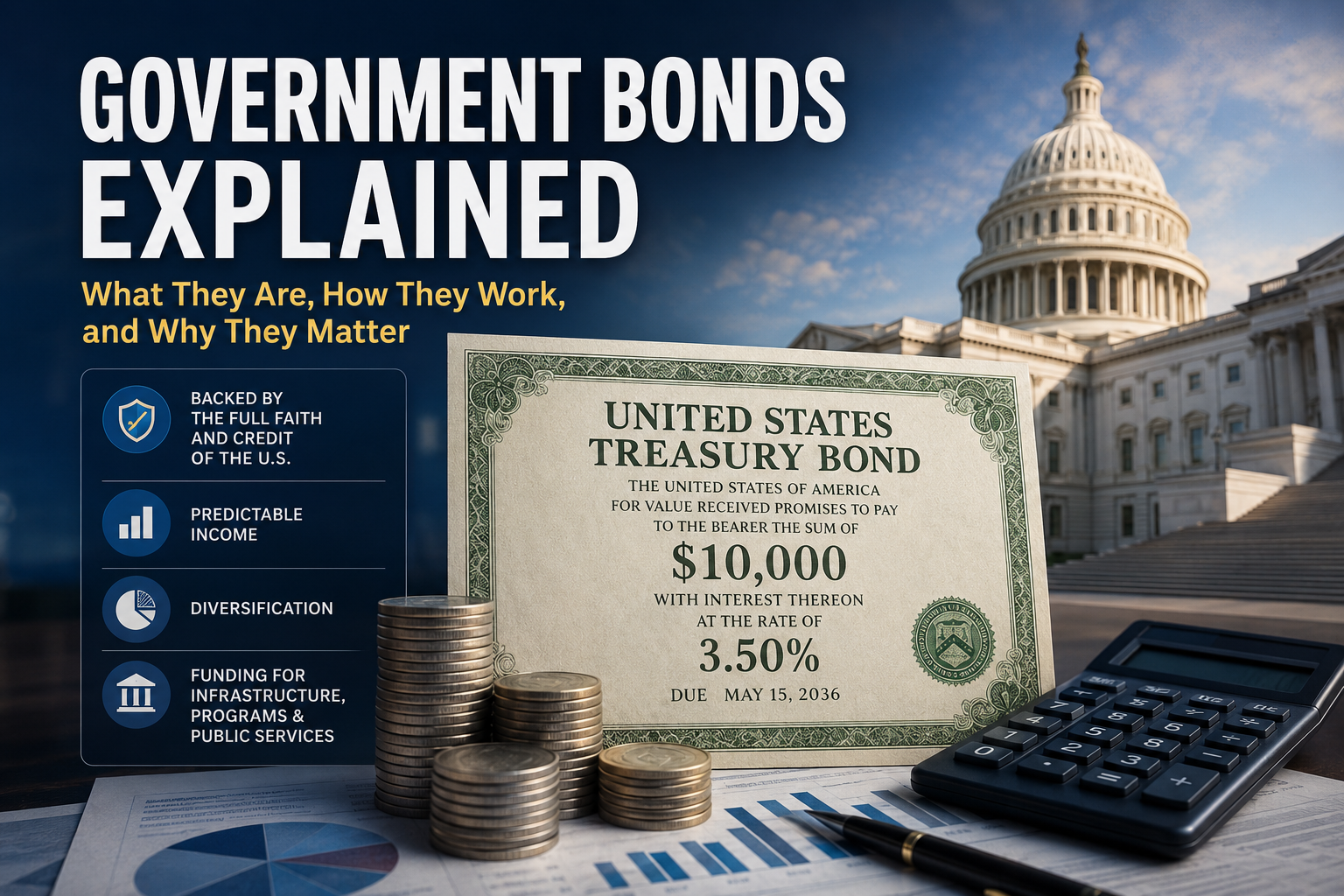
In the simplest terms, gov bonds are loans given to the government by investors. The government receives the cash upfront and agrees to pay back the investor the face value plus interest by the maturity date.
I know I just threw some random terms out there that might not make sense, so let me define them for you:
- Face value = the amount of money the government receives upfront
- Interest = the amount of money the government pays for borrowing that money upfront
- Maturity date = the date in which the face value is repaid in full to the investor
But why do governments issue bonds?
Governments issue bonds for a few different reasons.
First, they need funding to build infrastructure. Think about building a bridge over a canal. The bridge would require extensive engineering, labor, and materials to complete the project. The problem is that most governments do not have that type of cash just sitting around, so they issue bonds to raise the money needed for projects like these.
Second, governments may issue bonds to help pay for public programs. For example, if there is a surge in homelessness in an area, a local government may issue bonds to fund shelters and support programs to help people get off the streets.
Lastly, governments issue debt to help cover budget deficits. Governments, like normal businesses, are not immune to difficult economic periods and spending shortfalls. Issuing gov bonds allows them to continue operating during challenging times.
Types of Gov Bonds
Not all government bonds are the same. Different types of bonds are designed for different time horizons, risk levels, and investing goals.
Some government bonds are meant for short-term savings, while others are designed to provide stable income over decades. Understanding the differences can help you choose the right type of bond for your financial situation.
Here are the main types of government bonds investors should know about.
Treasury Bonds (T-Bonds)
Treasury bonds, commonly called T-bonds, are long-term debt securities issued by the U.S. government with maturities ranging from 20 to 30 years.
These bonds pay investors a fixed interest rate every six months until the bond matures. Once the maturity date arrives, the government repays the original investment amount.
Treasury bonds are popular among:
- Retirees seeking predictable income
- Conservative investors
- People looking for long-term stability
Because they are backed by the U.S. government, Treasury bonds are generally considered one of the safest investments in the world.
The tradeoff, however, is that they usually offer lower returns compared to stocks over long periods.
Treasury Notes (T-Notes)
Treasury notes are medium-term government bonds with maturities ranging from 2 to 10 years.
Like Treasury bonds, they pay fixed interest payments every six months. The main difference is simply the length of time until maturity.
Treasury notes are extremely popular because they strike a balance between:
- Stability
- Income
- Flexibility
The 10-year Treasury note is especially important because it influences:
- Mortgage rates
- Auto loan rates
- Corporate borrowing costs
- Overall interest rates across the economy
When you hear financial news discussing “Treasury yields,” they are often referring to Treasury notes.
Treasury Bills (T-Bills)
Treasury bills are short-term government securities that mature in less than one year.
Unlike most bonds, T-bills do not pay traditional interest payments. Instead, they are sold at a discount and mature at full value.
For example:
- You may buy a Treasury bill for $970
- When it matures, you receive $1,000
- The difference is your return
Treasury bills are commonly used by investors who want:
- A safe place to store cash
- Short-term liquidity
- Protection during uncertain markets
Because they have short maturities, T-bills tend to have lower risk from changing interest rates.
Series I Savings Bonds
Series I Savings Bonds, commonly called I Bonds, are designed to protect investors from inflation.
These bonds have two components:
- A fixed interest rate
- An inflation-adjusted rate that changes every six months
When inflation rises, I Bond rates typically rise as well. This made them especially popular during periods of high inflation in recent years.
I Bonds have a few restrictions:
- They must be held for at least one year
- Redeeming before five years results in a small interest penalty
- Annual purchase limits apply
Still, many investors use I Bonds as a low-risk savings vehicle that helps preserve purchasing power.
Municipal Bonds (Munis)
Municipal bonds are issued by state and local governments rather than the federal government.
These bonds help fund public projects such as:
- Schools
- Roads
- Airports
- Hospitals
- Water systems
One of the biggest advantages of municipal bonds is their tax benefits. In many cases:
- Interest income is exempt from federal taxes
- It may also be exempt from state taxes
Because of these tax advantages, municipal bonds are especially attractive to higher-income investors.
The municipal bond market is also massive, with roughly $4.4 trillion in debt outstanding in the United States.
Risks of Government Bonds
While government bonds are often viewed as safe investments, they are not risk-free.
Understanding the downsides is just as important as understanding the benefits.
Inflation Risk
Inflation is one of the biggest threats to bond investors.
If inflation rises faster than your bond yield, your purchasing power declines.
For example, imagine your bond earns 3% annually while inflation runs at 5%.
Even though your account balance is growing, your money is effectively losing purchasing power.
This is why many investors look at inflation-protected investments such as I Bonds during periods of high inflation.
Interest Rate Risk
Bond prices move inversely to interest rates.
When interest rates rise, existing bond prices tend to fall.
Why?
Because newer bonds become more attractive if they pay higher yields.
For example, imagine you own a bond paying 3% interest. If new bonds suddenly pay 5%, investors are less likely to want your bond unless it sells at a discount.
This matters most if you plan to sell bonds before maturity.
Lower Long-Term Returns
Government bonds are generally safer than stocks, but that safety comes with a tradeoff.
Historically, stocks have significantly outperformed bonds over long periods.
While bonds help reduce risk and volatility, relying too heavily on them may slow wealth growth.
For younger investors with long time horizons, too much money in bonds could mean sacrificing long-term gains.
Opportunity Cost
Opportunity cost simply means missing out on potentially better returns elsewhere.
Money tied up in low-yield government bonds may have earned more in:
- Stocks
- Real estate
- Business investments
- Higher-yield investments
That does not mean bonds are bad investments, but they should fit into a broader financial strategy.
How to Buy Government Bonds
Buying government bonds is easier than most people think.
You do not need to be wealthy or work with a financial advisor to invest.
Here are the most common ways to buy government bonds.
TreasuryDirect
One option is buying bonds directly from the government through TreasuryDirect.
This platform allows investors to purchase:
- Treasury bills
- Treasury notes
- Treasury bonds
- I Bonds
Buying directly means you avoid brokerage commissions and can hold securities until maturity.
However, some investors find the website less user-friendly than brokerage platforms.
Brokerage Accounts
You can also buy government bonds through brokerage firms.
Popular brokerages allow investors to purchase:
- Individual Treasury securities
- Bond ETFs
- Bond mutual funds
Brokerage accounts may offer a simpler experience and more flexibility if you want to trade or sell investments before maturity.
Bond ETFs and Mutual Funds
Many investors prefer bond funds because they provide instant diversification.
Instead of buying one bond, a bond ETF or mutual fund owns many bonds at once.
Benefits include:
- Diversification
- Easier management
- Liquidity
- Lower investment minimums
The downside is that bond funds behave differently than individual bonds because they typically do not mature in the same way.
Conclusion
So, what are gov bonds?
In simple terms, government bonds are loans investors make to governments in exchange for interest payments and eventual repayment of principal.
They are popular because they provide:
- Stability
- Predictable income
- Portfolio diversification
- Lower risk compared to stocks
At the same time, government bonds come with tradeoffs such as inflation risk, lower long-term returns, and interest rate sensitivity.
For many investors, government bonds work best as part of a diversified portfolio rather than a replacement for stocks.
The key is understanding how they fit into your financial goals, timeline, and risk tolerance.g how they fit into your financial goals, timeline, and risk tolerance.