
Every so often we hear or see something that completely changes the way we think or perceive the world around us.
Not because it’s complicated.
Not because it’s profoundly deep.
But because of how insanely simple it is.
That’s exactly what happened to me the other day when I was listening to Steven Bartlett’s Diary of a CEO podcast featuring Gelong Thubten, a famous monk.
He said, “The more we want, the less we feel like we have.”
Oh my god.
Right then and there I realized that I’ve fallen into the wanting-more pattern way more than I would ever like to admit.
And I know that I’m not alone in this because businesses understand this mindset and exploit it to their advantage.
Let me give you a real-world example.
Buying my Dream Truck
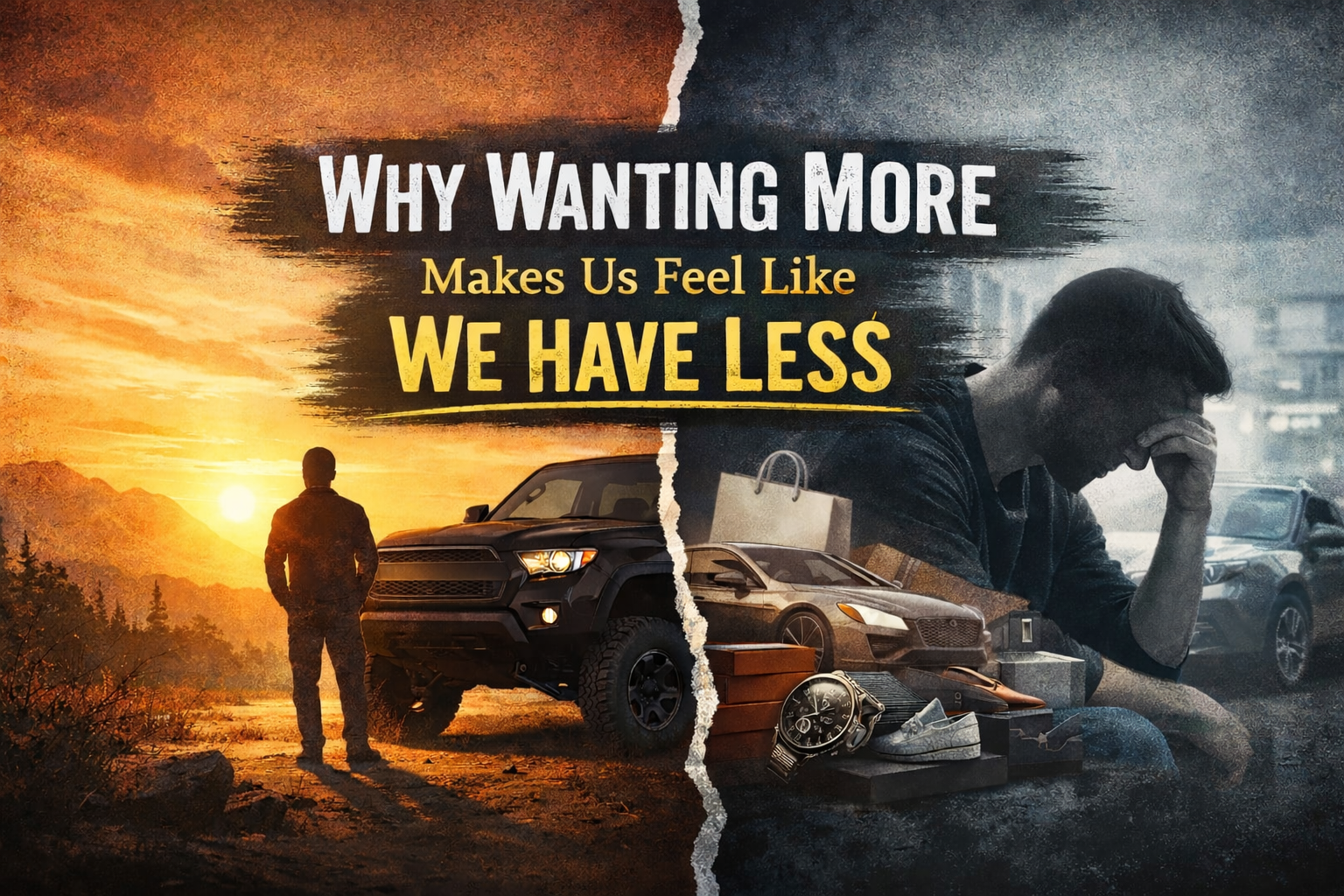
A little over 5 years ago I bought what I consider to be my dream truck. It was a brand new, all blacked-out Toyota Tacoma with a 3-inch lift kit and big 33-inch mud tires.
To me, the truck just screamed tough, cool, and for lack of a better term, badass. When driving this truck, I just had this overwhelming feeling that I was the coolest person on the road that day.
As I’m sure you can tell, I spent a pretty penny on it.
Fast forward to a year later and now the truck has lost all of its luster. It became just another car to get me from point A to point B.
I no longer had this emotional high from driving the truck around. I no longer tried to show it off. And on top of this, Toyota released a redesigned version of the truck.
Now my truck felt old, dated, and lame, which in turn made me feel the same.
Which led me to wanting more. I started to view car dealership online listings and was Googling what the market value of my truck was, all to quiet this voice inside my head.
Did I need it? Absolutely not.
Would it have been a smart decision? God no.
Clearly my wants were screaming, and the manufacturer knew how to amplify that voice in my head.
Luckily for me, I didn’t do anything drastic (I still have the truck I bought 5 years ago). I found ways to quiet that voice in my head. The thoughts were still there, but muffled.
The problem is, though, that the feeling of want never really left, and it led me to overlook the things that I had right in front of me. And that’s where this quote from Gelong Thubten really hit home.
This wasn’t about the truck.
It was about the feeling of wanting more.
Why does this happen?
Hedonic Adaption
Psychologists call it hedonic adaptation, which is defined as the notion that the feelings you experience as a result of positive or negative life events essentially return to a relatively stable baseline level of happiness after those events occur, per PsychCentral.
In layman’s terms, it means that buying something at first will cause increased excitement. However, over time that excitement will fade away and we will return to our equilibrium.
What felt extraordinary will become ordinary, and we repeat the cycle over and over again.
The Dangers of falling into the Trap
My story is a little extreme in that I bought a $55k truck and felt ready to upgrade it in a year. However, the sad reality is that we as consumers are falling into this in all walks of the market.
For example, look at the shoe market. People will spend hours waiting in line for the latest shoe drop.
What about individuals who wear watches? If you ask most of them, they have way more than one watch.
The list goes on and on and on.
We don’t stop at one purchase. We buy it, feel excited for a short bit, and then rinse and repeat. We are stuck wanting more.
And it’s clear that this spending is ruining our financial health.
For instance, if I hadn’t bought the truck and invested that money instead, it would have compounded to almost $60k by the end of my loan. And if I left that money invested for 30 years, it would grow to $841k.
And this habit quietly costs consumers thousands of dollars every year.
Business Exploitation
It doesn’t take an expert to see that businesses know this and exploit it to their advantage.
Every redesign of a car, every new color shoe, every “new and improved” product they release isn’t about function or product improvement. It’s about reigniting that desire within your head.
Let’s look at the car example. Every few years they redesign their cars, and as such they might add a few safety, tech, or comfort features. But does that really change the purpose of the car?
Absolutely not. The car’s main purpose is to get you from point A to point B, not give you unlimited entertainment options while driving yourself from point A to point B.
Life issue
While I dove into the more financial issues surrounding this, it actually goes much deeper than that.
This is actually a life issue. When we are wanting more, we are overlooking the very things that we have.
That over time makes us envious of the others around us. It makes us feel as if our life isn’t complete until we get that new item.
It creates a feeling of dissatisfaction that we can’t quite shake.
But there are ways to quiet those pesky wants.
How to Keep those wants at Bay
Over the years I have learned a few things to keep my wants at bay, which are summarized below:
Utilize a 24–48 hour waiting period. This gives me key time to really think if I want or need this new item.
Calculate the real and opportunity cost of buying this item. Especially for big-ticket items like a new car, this can show you how much it is really costing you to buy something.
Set specific financial goals and stick to them. With tangible goals we will push ourselves to reach them, and if this new item doesn’t fit within these goals we are much more likely to pass on buying it.
Create more friction within the buying process. Remove saved credit card information, turn off one-click purchasing, etc.
Conclusion
That truck taught me something I didn’t expect.
The problem was never what I owned.
The problem was the constant feeling of wanting more and that I needed something better.
Businesses will always try to make us want more. That’s their job.
But learning to be satisfied with what we already have, that’s ours.
Because the more we chase “more,” the harder it becomes to see that we already have enough.