
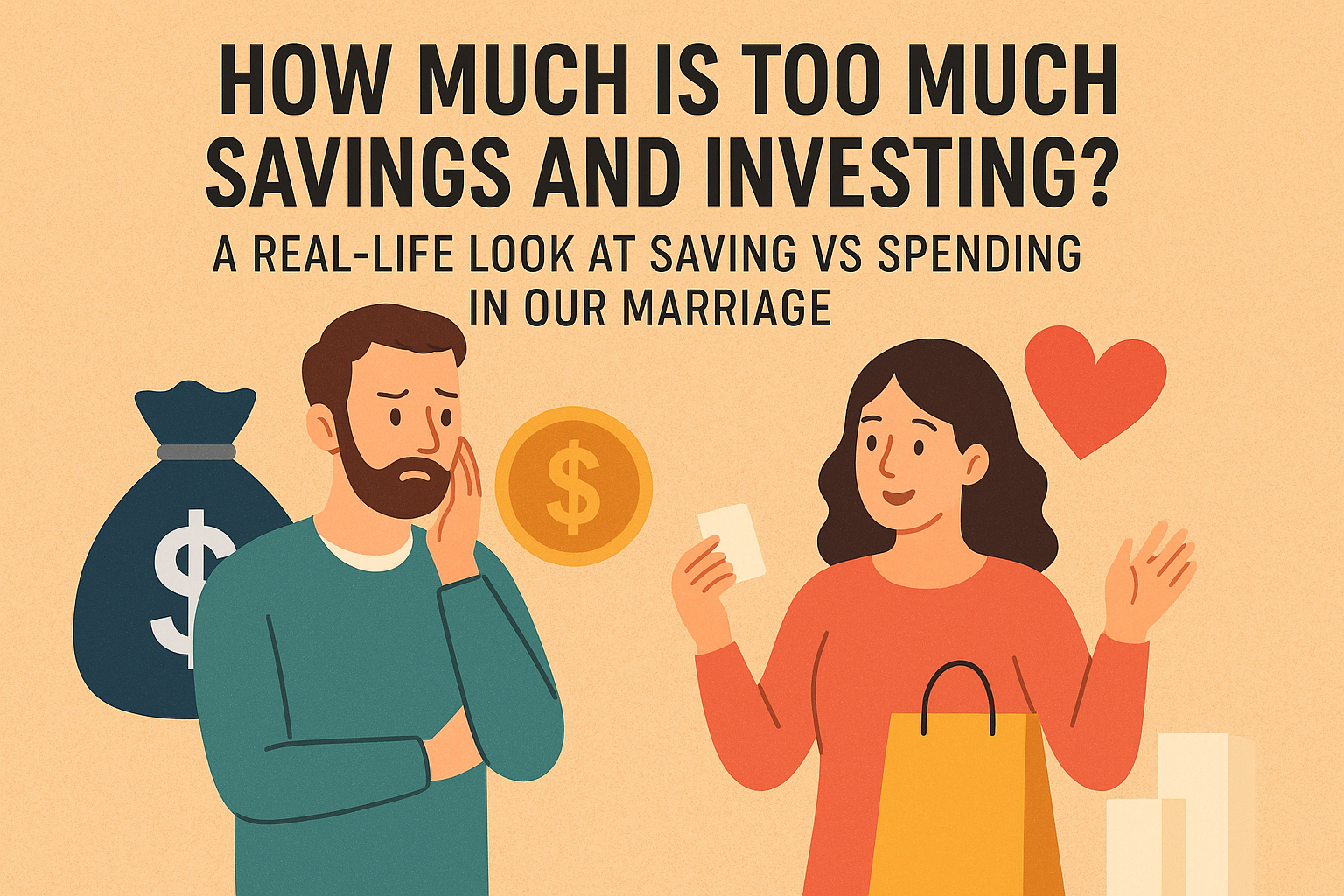
A Real-Life Look at Saving vs Spending in Our Marriage.
I’ll admit it I love saving money. Few things give me as much satisfaction as watching our investment accounts grow, seeing compound interest do its quiet magic in the background, and knowing the future is getting more secure with every deposit.
My wife, on the other hand? She’d rather enjoy the money now. Trips, experiences, a new couch when the old one still works “just fine” (in my opinion). To her, money is meant to be used, not just admired.
And honestly… she’s not wrong.
This tension between saving and spending has been one of the most fascinating parts of our marriage. I want to maximize the future; she wants to maximize the present. And somewhere between the two of us lies the real sweet spot enough savings to feel secure, but not so much that we miss out on life today.
The Saver’s Side (That’s Me)
I grew up believing financial security was everything. Savings meant safety. Investing meant freedom. The earlier you start, the better off you’ll be. I grew up living this so much that my brother in his best man speech at my wedding made fun of how much of a saver I am.
So my instinct is to put every extra dollar into the market. Why buy concert tickets when that same money could compound into something bigger? Why upgrade the car if the old one still runs?
I’m motivated by this picture of our future: retiring early, never stressing about bills, and leaving a legacy for our kids. For me, saving is not about deprivation it’s about preparation.
The Spender’s Side (That’s My Wife)
Bianca has a different perspective. She sees money as a tool for joy. Why wait until retirement to live well when we can afford to do meaningful things now?
She’ll say: “What’s the point of building this big future if we’re too tired or too old to enjoy it?”
And she’s right. Time doesn’t wait. Our health, our energy, and our relationships won’t all be the same twenty years from now. She’s constantly reminding me that some experiences have an expiration date.
For her, spending isn’t recklessness it’s intentional living.
The Hidden Cost of Over-Saving
At first, I thought my way was the “responsible” way. But the more I reflect, the more I realize that saving too much comes with its own hidden costs.
- Lost Time: If I keep saying “someday,” I might miss the window when travel, adventure, or even just simple family moments are possible.
- Neglected Joy: By refusing to spend, I sometimes undervalue experiences that could actually enrich our lives.
- Moving the Goalpost: Every time we hit a savings milestone, my instinct is to set the bar higher. $1M becomes $2M, $2M becomes $3M. It’s a never-ending game.
Bianca helps me see that “enough” is a moving target if I don’t define it and that chasing endlessly can mean we’re living less today.
The Hidden Cost of Over-Spending
Of course, it works both ways. If we only followed Bianca’s philosophy, we’d have a blast now but potentially shortchange the future.
- Retirement could be stressful instead of secure.
- We’d always need the next paycheck, even when we’re exhausted.
- Generational wealth and giving opportunities would be off the table.
Her instinct is fun, but my instinct is protection. Too much of either one and things fall out of balance.
Finding Balance in Saving vs Spending
The biggest thing we’ve realized is that there’s no universal answer to saving vs spending. The real question is: Are we saving and spending in a way that honors both today and tomorrow?
Here’s what’s worked for us:
1. Defining “Enough”
We actually sat down and ran the numbers. What does financial independence look like for us? How much do we truly need to retire comfortably? Once you have that number, you realize when you’re past the point of security and into the land of over-saving.
2. Creating a “Joy Fund”
We built a line in our budget specifically for experiences trips, date nights, things that feel indulgent. That way, spending feels intentional, not irresponsible. When that money is gone, we don’t feel guilty it was meant to be used.
3. Practicing the “Future Me Test”
Now when we face a decision, we ask: Will future us thank us for this? Sometimes the answer is “yes, let’s invest it.” Other times, it’s “yes, let’s go to Europe while we can still hike those cobblestone streets without bad knees.”
4. Remembering That Balance Is the Goal
I’ve come to see our different instincts not as a conflict but as a balance. I protect our future; she protects our present. Together, we make sure neither gets neglected.
A Few Stories of Saving Vs Spending That Hit Home
- The Cautionary Tale: I recently had a coworker who worked relentlessly, saved million and was a year or two away from retiring. Then one day it was announced at work that he was diagnosed with cancer and would be taking a leave of absence to address this health emergency. Unfortunately he passed away 6 months later. His nest egg was full, but his time to enjoy it was gone. That’s the danger of leaning too far toward “saving” in saving vs spending.
- The Flip Side: On the other hand, I’ve also seen family friends who lived lavishly, spent every dollar, and reached retirement age with very little. And are forced to keep working, the stress has aged them faster than any job could. That’s my nightmare scenario.
So, How Much Is Too Much?
For me, saving and investing becomes too much the moment it keeps me from saying “yes” to experiences that matter with the people I love most.
For Bianca, spending becomes too much the moment it threatens our ability to build a stable, secure future.
The truth is, saving vs spending isn’t a competition it’s a balancing act.
Final Takeaway for Saving Vs Spending
Here’s what I’ve learned being married to someone with the opposite money instinct:
- Saving is good. It creates freedom.
- Spending is good. It creates memories.
- But either one, taken to the extreme, can rob you of the life you actually want.
The real goal isn’t maximum savings or maximum spending it’s balance. Enough to secure the future, but enough freedom to live fully today.
So now, instead of asking “How much should we save?” or “Should we buy this?” I’ve started asking:
👉 “Are we building both a secure future and a joyful present?”
Because in the end, the best return isn’t just financial it’s the return on life we get along the way.