
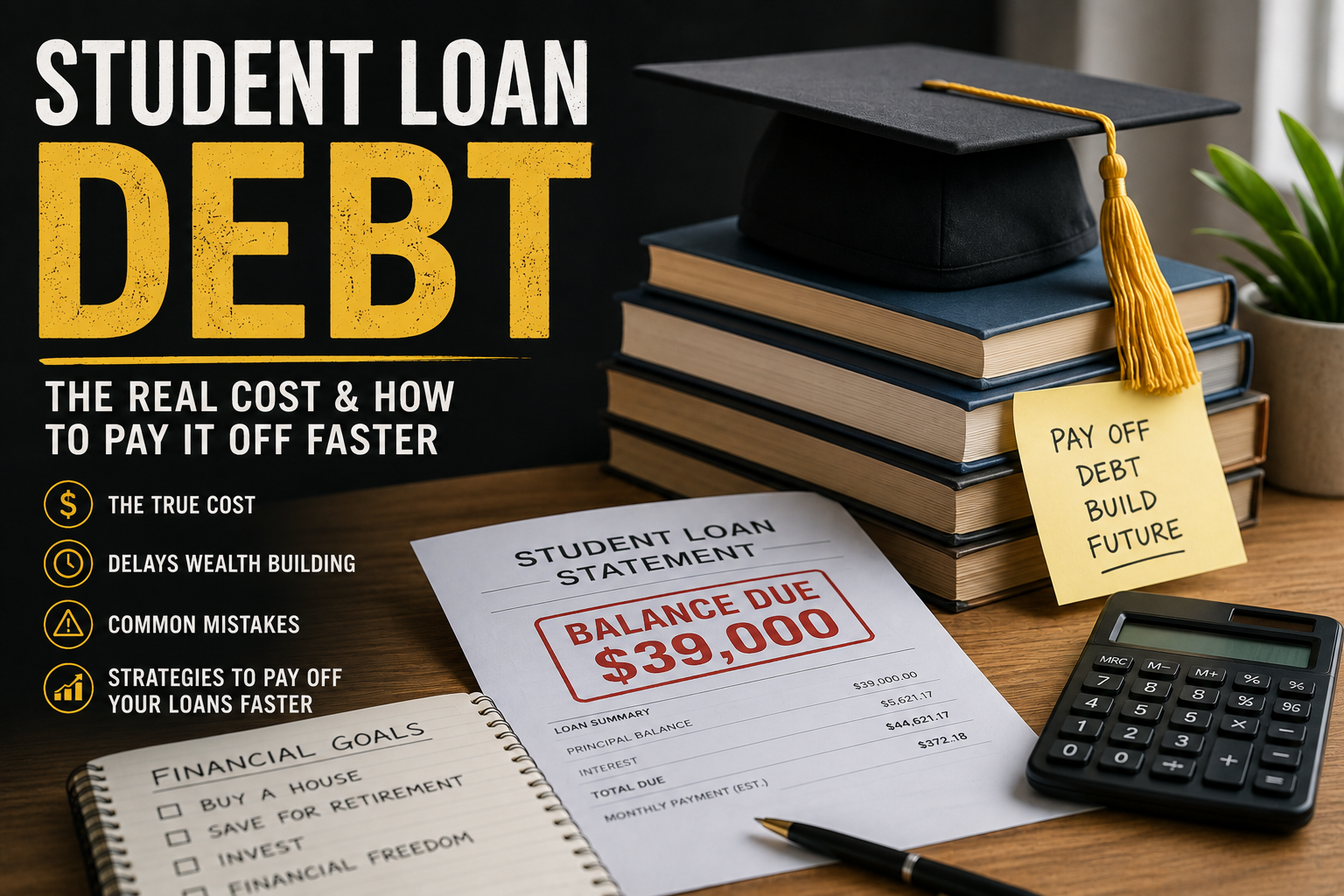
$39,000.
That’s the average federal student loan balance per borrower.
Nearly 1 in 7 Americans have student loans, with a total of $1.8 trillion in student loan debt across the United States.
It feels like we’re the land of the free, home of the brave, and financially crippled by student loan debt.
The problem with this amount of debt is that it has caused many Americans to delay major financial goals such as buying a house, investing, and saving for retirement.
In fact, student loan debt has become such a major issue that some politicians have floated the idea of student loan forgiveness programs.
While it would be nice to have these loans forgiven, I wouldn’t count on it. Fortunately, there are several practical ways to regain control and get out of debt once and for all.
The True Cost of Student Loan Debt
As I mentioned earlier, the average federal student loan balance is $39,000. If you apply a standard 10-year repayment plan to that balance, you will likely pay between $300 and $400 per month, depending on the interest rate.
Additionally, that is usually only for individuals who took out loans for their undergraduate degree. This amount can balloon significantly for those pursuing advanced degrees such as doctorates, law degrees, and other professional programs.
Sure, there are income-driven repayment plans that can reduce the monthly payment if your income isn’t very high. However, they simply stretch out the repayment length and can cost you thousands of dollars in additional interest over time.
There is also a huge opportunity cost component. The higher your payment and the longer it takes to repay your loans, the less money you have available for saving and investing for your future.
Why Student Loan Debt Feels So Overwhelming
One of the biggest reasons student loan debt feels overwhelming is because college has become so expensive that many students are forced to take out large loans. On top of that, it causes many graduates to enter the workforce already behind financially.
Basically, in order to start working, many people have to put themselves in a difficult financial position. Then they spend years trying to get back to level ground.
Additionally, student loan debt feels overwhelming because graduates are forced to start paying a large monthly bill at a time when their incomes are often at the lowest point of their careers.
Take my situation, for example. When I graduated in 2013, my starting salary was $35,000 per year. Fortunately, I only had about $10,000 in student loans. Even then, the monthly payment was a meaningful amount of money.
I can’t help but wonder what things would have looked like if I had owed the average balance. Making a $400 payment every month would have been financially crippling for me.
How Student Loan Debt Delays Wealth Building
One of the biggest ways student loan debt delays wealth building is by taking money you’ve earned and forcing you to use it elsewhere.
First, it reduces your ability to build an emergency fund. If an unexpected expense arises, you may be forced to rely on credit cards rather than cash savings.
Second, it can prevent you from aggressively saving for retirement and investing. If $400 is going out the door every month to student loans instead of being invested, that decision could cost you hundreds of thousands of dollars over a 40-year investing career.
Lastly, student loan debt can delay major financial goals such as homeownership. If you were able to save that $400 instead of sending it to a lender, you could build a larger down payment. A larger down payment reduces the principal borrowed, lowers interest costs over the life of the mortgage, and may even help you qualify for a better interest rate.
Common Mistakes People Make with Student Loan Debt
Like any type of debt, there are several mistakes people make that prolong the pain and make repayment harder than it needs to be.
The first is simply ignoring the loan. While “out of sight, out of mind” may feel good in the moment, it’s one of the worst things you can do. The loan continues to accrue interest, digging the hole even deeper. Don’t ignore your loans, tackle them head-on.
The second mistake is making only the minimum payment. Yes, you’ll eventually pay off the loan, but it could take years longer than necessary and cost you thousands of dollars in additional interest. This is especially true if you’re on an income-driven repayment plan and only make the minimum payment every month.
Lastly, many graduates fall victim to lifestyle inflation. Instead of continuing to live like a recent college graduate, they buy the fancy BMW or rent the luxury apartment that consumes most of their income.
Don’t fall into that trap. Live below your means, attack your debt aggressively, and make extra payments whenever possible to get out of debt as quickly as you can.
Strategies to Pay Off Student Loan Debt Faster
Make Extra Payments
The more money you apply toward principal, the faster you’ll eliminate the loan and the less you’ll pay in interest.
If you have multiple loans, consider using either the snowball method or the avalanche method to determine which debts to pay off first.
Increase Your Income
Whether it’s through promotions, side hustles, freelancing, or a second job, finding ways to increase your income can dramatically accelerate your debt payoff journey.
The sooner you can eliminate your debt, the sooner you’ll be able to focus on building wealth.
Lower Your Expenses
Increasing your income is powerful, but it’s only half the equation. If you can reduce your monthly expenses, you’ll free up additional cash that can be directed toward debt repayment.
Maybe that means living in a cheaper apartment, getting a roommate, cooking more meals at home, or using public transportation. Every dollar you save is another dollar that can help you become debt-free faster.
What I’d Do If I Had Massive Student Loan Debt Today
If I had just graduated and was carrying a large amount of student loan debt, here’s what I would do.
First, I would continue living the same way I did in college. I’d stay in the cheap apartment, use public transportation whenever possible, shop at discount grocery stores, and look for low-cost or free entertainment.
Second, I would push myself as hard as possible at work to develop my knowledge, skills, and reputation. While I can’t directly control whether I receive a promotion, I can control my effort and performance. Over time, those things increase the likelihood of earning raises and promotions.
Third, I’d create a budget and decide exactly how much debt I want to pay off each month before spending money on entertainment or other discretionary purchases. Building wealth and paying down debt should be priorities, not afterthoughts.
Lastly, I wouldn’t compare myself to others. Keeping up with the Joneses is one of the fastest ways to destroy your finances. While it may seem like your peers are more successful, appearances can be deceiving. Many people are financing their lifestyles with debt while you’re building a stronger financial foundation.
Student Loan Debt Doesn’t Have to Define Your Life
I get it. Student loan debt can feel overwhelming, especially when the average borrower owes $39,000.
But that debt doesn’t have to define your future.
There are plenty of strategies that can help you eliminate student loans faster and regain control of your finances. The path may not be easy, and unfortunately there is no magic button that makes the debt disappear overnight.
However, if you stay disciplined, increase your income, control your expenses, and consistently make progress, you can eventually eliminate your student loans and start putting your money toward building wealth instead of paying for the past.
The sooner you take action, the sooner you’ll be able to move on from student loan debt and focus on achieving the financial goals that matter most to you.