
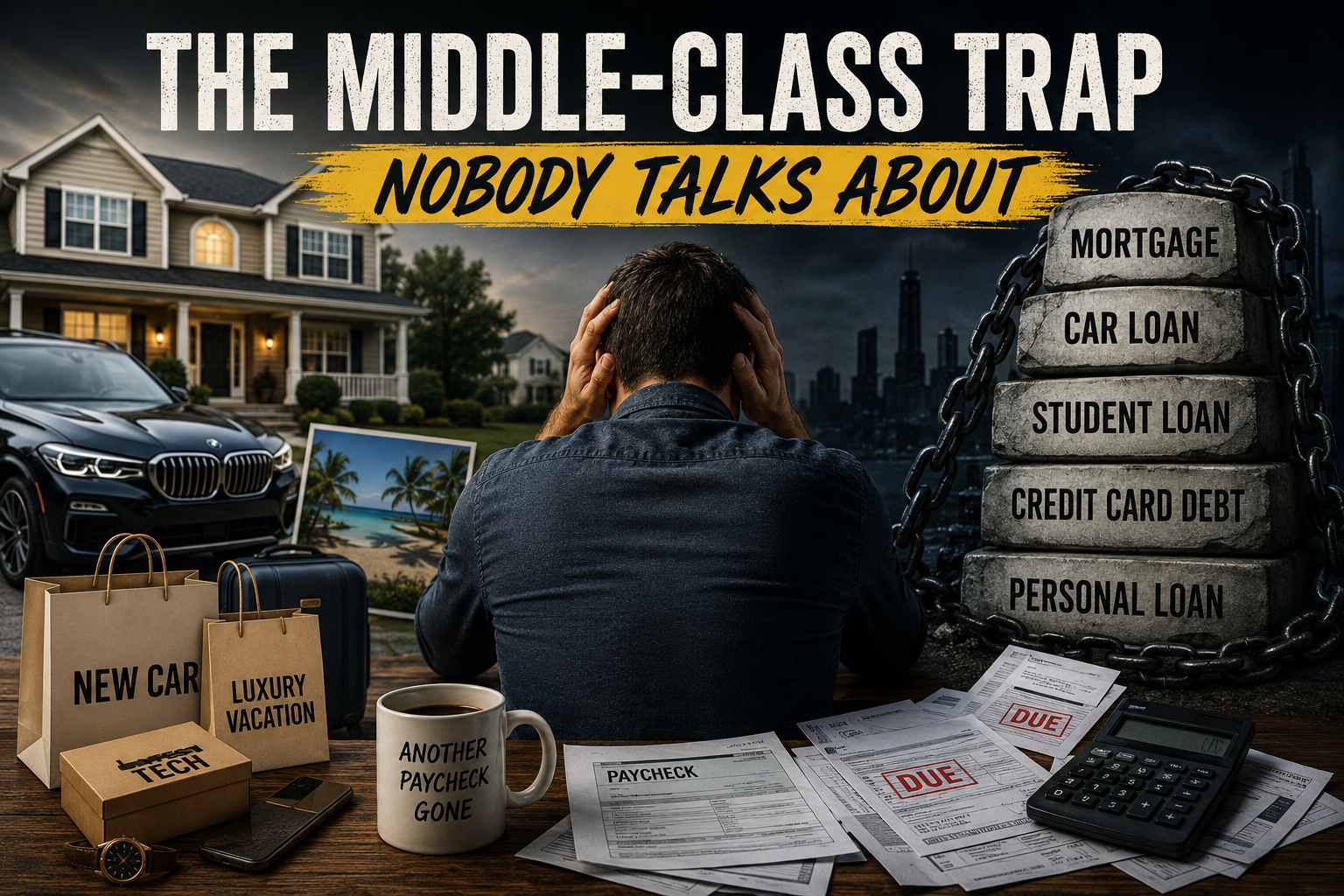
38% of households earning $100,000 or more reported living paycheck to paycheck, according to a 2025 NerdWallet survey.
And that number jumps to 44% for households earning between $50,000 and $99,999.
Four out of 10 households making what most people consider fairly comfortable incomes are struggling to create real financial stability.
While these households are not living in poverty, they have become financially dependent on maintaining and growing a certain lifestyle.
These families technically earn enough to build wealth, but lifestyle creep has led them astray with crippling debt and a constant need to keep up appearances at the expense of their future wealth.
What Is the Middle-Class Trap?
The middle-class trap is something that is fairly easy to spot to a trained eye.
Just think about your neighbor. They come home smiling ear to ear with the news that they just received an amazing promotion and a huge pay increase. Then within a few days, you notice them driving a brand-new car. Next, you see fancy vacations on social media or a new toy sitting in the front yard.
The thing about the middle-class trap is that people are trained to spend.
They get a new promotion and pay raise, and their expenses rise just as fast.
Their wealth never truly grows, and in extreme cases, it actually shrinks if they are using debt to finance these new purchases.
Lifestyle Inflation Is the Real Enemy
As I mentioned before, when our income rises, so do our expenses.
The house or apartment gets bigger and nicer. Vacations become more luxurious and expensive. The clothes we wear become designer brands, and the cars we drive turn into luxury vehicles.
This leads us to normalize spending and creates the illusion that we are doing incredibly well financially.
It happens because of comparison culture. We see our neighbors buying these things, which leads to “keeping up with the Joneses.”
Additionally, new job promotions often come with more stress, so we justify spending by telling ourselves, “I deserve this.”
And with a higher income, lenders are willing to give you more money. It becomes harder to buy the cheaper car when you can afford the fancy one sitting in the showroom.
It is clear that the middle class upgrades its lifestyle faster than it upgrades its wealth.
Debt Creates Invisible Financial Tie Downs
Debt is one of the most crippling financial burdens facing the middle class.
And the problem is not that people have one form of debt they often have multiple forms of debt, which leads them to work simply to pay it all back. In fact, the Federal Reserve found that middle-class households typically carry between three and four forms of debt.
Some common forms of debt include:
- Mortgage payments
- Car loans
- Student loans
- Credit card debt
- Furniture financing
The problem with this is that the middle class shifts from a wealth-building mindset to a survival mindset. They spend day after day just trying to stay afloat and make all of their payments.
That is unfortunate because it limits your freedom. You may not be able to leave a job you hate, take a risk to follow a passion, or survive a financial emergency very well.
So remember: debt is not your friend. Its purpose is to keep your net worth chained down.
The System Rewards Looking Rich Instead of Becoming Rich
One of the biggest problems today is social media. It makes us feel like we need to constantly show off the latest and greatest things.
We feel pressured to display our new cars, bigger houses, fancy vacations, and designer clothes.
These are loud purchases that attract attention and social media likes. They create the appearance that everything is going well financially, but in many cases, it is not.
Real wealth-building is actually the opposite. It is mostly invisible.
Instead of buying a new toy, wealthy people often focus on building:
- Well-funded retirement accounts
- Paid-off homes
- Fully funded emergency funds
- Income-producing assets
They are not making flashy purchases for a few likes on social media. They are quietly stacking assets while nobody is paying attention.
How to Escape the Middle-Class Trap
While the middle-class trap can feel nearly impossible to escape, there are several ways to dig yourself out.
Lower Fixed Expenses
One of the best ways to escape the trap is to look at the largest expenses in your budget and find ways to reduce them.
Have a massive mortgage payment? Consider downsizing to something more affordable.
Renting a luxury apartment? It may be time to move into something that better aligns with your income level.
Additionally, do not overlook transportation costs. Owning a fancy car is incredibly expensive and can easily keep you trapped financially.
Get rid of the BMW that costs a fortune in maintenance, insurance, gas, and monthly payments, and buy a reliable used Honda Civic instead. The money you save can then be invested.
Lastly, focus on eliminating debt faster. Have a large car payment? Sell the car and remove the debt. Carrying credit card balances? Do whatever you can to pay them off aggressively.
Avoid Lifestyle Creep
I know it is hard not to increase your spending after getting a promotion. But one of the best things you can do for your financial future is to save and invest most of that additional income instead.
Trust me, the excitement of buying a new car or bigger house eventually fades, and you are often left spending even more money trying to recreate that feeling.
Build Assets
The goal is to stop collecting payments and start collecting assets.
Instead of accumulating:
- Car payments
- Credit card payments
- Consumer debt
focus on building things that either appreciate in value or generate income.
Examples include:
- Retirement accounts
- Brokerage accounts
- Real estate
- Cash-flowing assets
Prioritize Flexibility
Change your financial goals.
Instead of thinking about what stuff you are going to buy, think about buying freedom and flexibility.
Imagine how great it would feel to walk away from a job you hate because you have enough money saved.
Imagine being able to pick your child up from school on a Wednesday afternoon or go to the gym at 10 a.m. on a Tuesday.
The real financial flex is not the fancy car or the big house.
It is having options and freedom every single day of your life.
Conclusion
The middle-class trap is one of the most dangerous financial traps to fall into. From the outside, it looks like you are succeeding, but in reality, you are trapped working longer and harder just to maintain a lifestyle.
You may think you are happy driving a new car every few years or enjoying an expensive backyard renovation. But the longer you need to work to maintain those things, the less freedom and flexibility you actually have.
Escaping the trap is less about making more money and more about being intentional with your spending, your lifestyle, and the kind of freedom you truly want to build.