
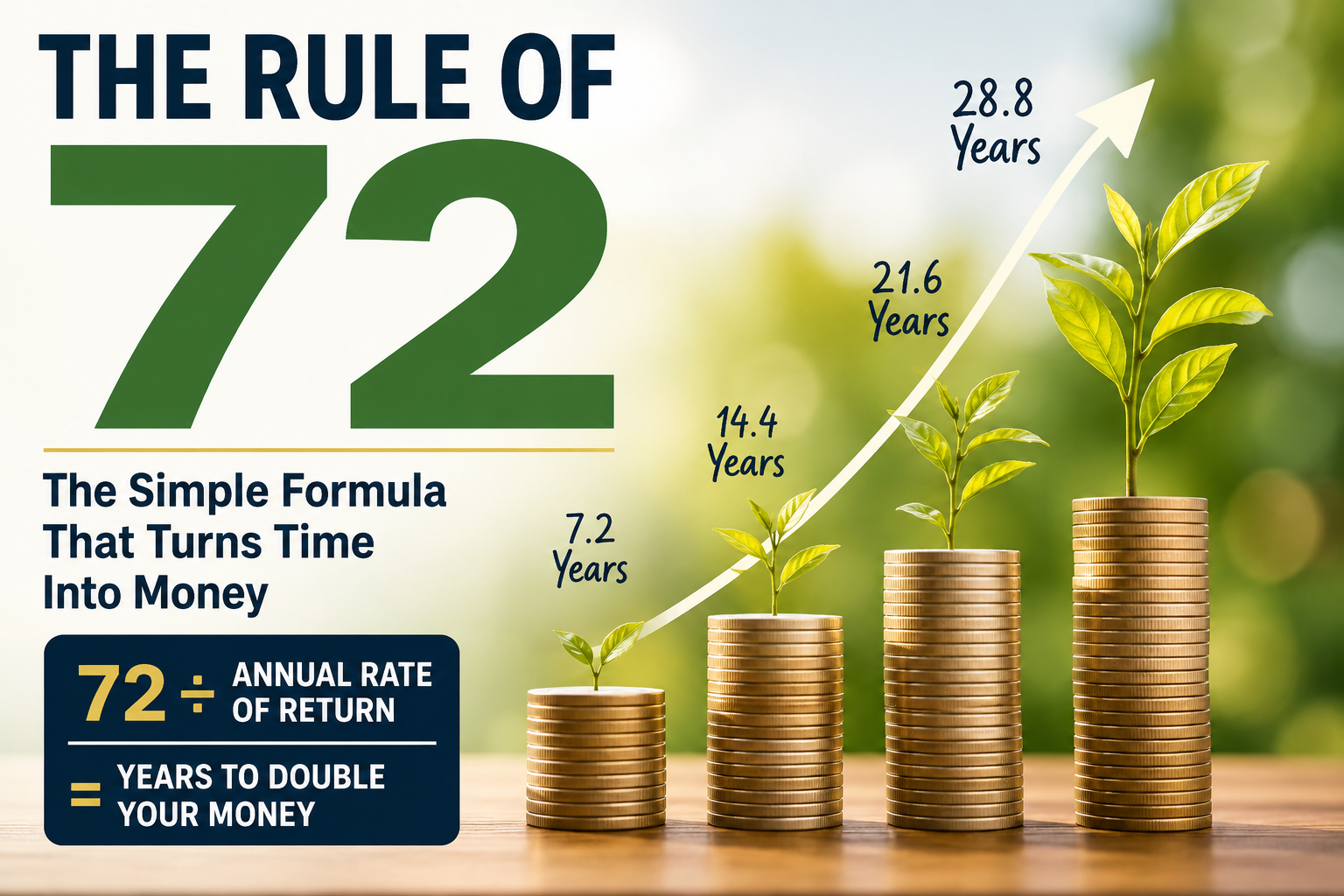
72 might just be the most important number in the personal finance game.
It’s not $72, or 72% interest, or anything else you might be thinking of.
It is, in fact, the Rule of 72, which is a simple yet incredibly effective way to understand the power of time. More importantly, it can estimate when your net worth will double in size.
What Is the Rule of 72?
As I said before, it’s a basic equation (shown below) that estimates how long it will take for your net worth to double.
72 ÷ Annual Rate of Return = Years to Double Your Net Worth
To put that into an example, let’s assume a 10% annual rate of return. The equation would look like this:
72 ÷ 10 = 7.2 years to double your net worth
Let that sink in for a minute.
It will take just over seven years to double your money, assuming a 10% annual rate of return.
Meaning, if you’re a millionaire at age 40, you could have approximately $2 million by age 47, assuming your investments continue earning that average return.
The best part about this equation?
No calculators or spreadsheets needed. It’s simple math that can be done in your head at any time.
Why Does This Rule Matter?
It matters because it demonstrates the power of compounding and the power of time, even when compound growth seems invisible.
Let’s break it down.
Assume you have $100,000 invested and earn a 10% annual return. That means it will take about 7.2 years to double your money.
Now, let’s say you’re 30 years old and plan to retire at age 65. Here’s how your money could grow.
- Age 30 — $100,000
- Age 37 — $200,000
- Age 44 — $400,000
- Age 51 — $800,000
- Age 58 — $1,600,000
- Age 65 — $3,200,000
What do you notice?
I notice that the original $100,000 grew into an astonishing $3.2 million.
And yes, I know inflation exists, but $3.2 million is still nothing to scoff at.
Even more impressive, your investment ended up being 32 times larger than where it started.
That’s the power of compounding.
What a Difference a Few Years Makes
Another great thing about this rule is that it shows how delaying investing can drastically affect your final net worth.
Using our example above, let’s say you wait until you’re 37 years old before investing your $100,000.
By age 65, your investment would only grow to about $1.6 million.
That seven-year delay effectively cost you another $1.6 million.
Now let’s go the other direction.
What if you were 23 years old with that same $100,000 and let it compound until age 65?
You’d finish with approximately $6.4 million.
In this case, just 7.2 years can completely change your retirement.
What Else Can the Rule of 72 Be Used For?
While most people use the Rule of 72 to estimate how long it will take to double their investments, it can also be used to estimate how long it will take inflation to double your cost of living.
Let’s assume inflation averages 3%.
Using the Rule of 72:
72 ÷ 3 = 24 years
That means your cost of living would roughly double every 24 years.
To put that into perspective, if your annual living expenses are currently $80,000, then in about 24 years those same expenses could cost roughly $160,000 per year, assuming your lifestyle stays exactly the same.
That’s why simply saving money isn’t enough. Your money needs to grow faster than inflation.
The Real Lesson Behind the Rule of 72
The Rule of 72 isn’t a formula that tells you exactly what your investments will do or when you’ll be able to retire.
This rule is about perspective.
The sooner you invest, the sooner your money can begin doubling.
The longer you wait, the less wealth you’ll likely build over the long run.
The Rule of 72 is one of the simplest tools available to show you the long-term consequences of the financial decisions you make today.
So remember this: you don’t need to become an investing expert overnight.
You just need to give your money enough time to work.
Because in personal finance, time is often your greatest asset.
Leave a Reply