
95%.
That’s the percentage of day traders who lose money attempting this hustle.
When I first heard that statistic, I brushed it off. It felt like a scare tactic designed to keep average Joes like me from trying.
Plus, I was young and inexperienced in my investing journey. Even if the 95% statistic was true, I was convinced I wouldn’t be part of the majority.
I had read numerous books, listened to various podcasts, and watched countless YouTube videos. I thought I was fully prepared to jump into day trading with a full head of steam.
At least, that’s what I kept telling myself.
I got into day trading because of the social media posts, screenshots, and stories of traders making more money in 30 minutes than I earned during an entire two-week paycheck.
While I understood that losses were part of the game, I figured that if I stuck with it long enough, I’d eventually have more winning trades than losing ones. Maybe I could even make a career out of it.
So I dove in without ever paper trading in a simulator first, a mistake that nearly every experienced day trader warns beginners against.
But I couldn’t resist the thrill, the challenge, and the possibility of making easy money.
What social media doesn’t show you are the countless hours of studying, the emotional ups and downs, and the bruises you’ll take along the way.
Looking back, I wasn’t really investing or even day trading.
I was gambling and disguising it as “day trading.”
The Dangerous Part About Early Success
When I first started, I was trading a few hundred dollars at a time. It wasn’t enough to make me rich, but it also wasn’t enough to bankrupt me.
As I spent more time trading, I started experiencing some wins.
They weren’t huge, but they were enough to build confidence in my so-called “skills.”
Naturally, I began increasing the amount of money I was putting into each trade.
Then one fateful day, I invested about $500 into a single stock. Within five minutes, it shot up more than 100%.
I sold immediately and locked in a profit of about $600.
By far, it was the best trade I had ever made.
I felt unstoppable.
In my mind, there was no stopping me. I was convinced I had figured it out and was ready to continue growing both my account and my skills.
Then reality hit.
The very next day, I lost $300 within the first five minutes of trading.
Instead of accepting the loss, I did what so many inexperienced traders do I started chasing it.
Trade after trade, I tried to earn it back.
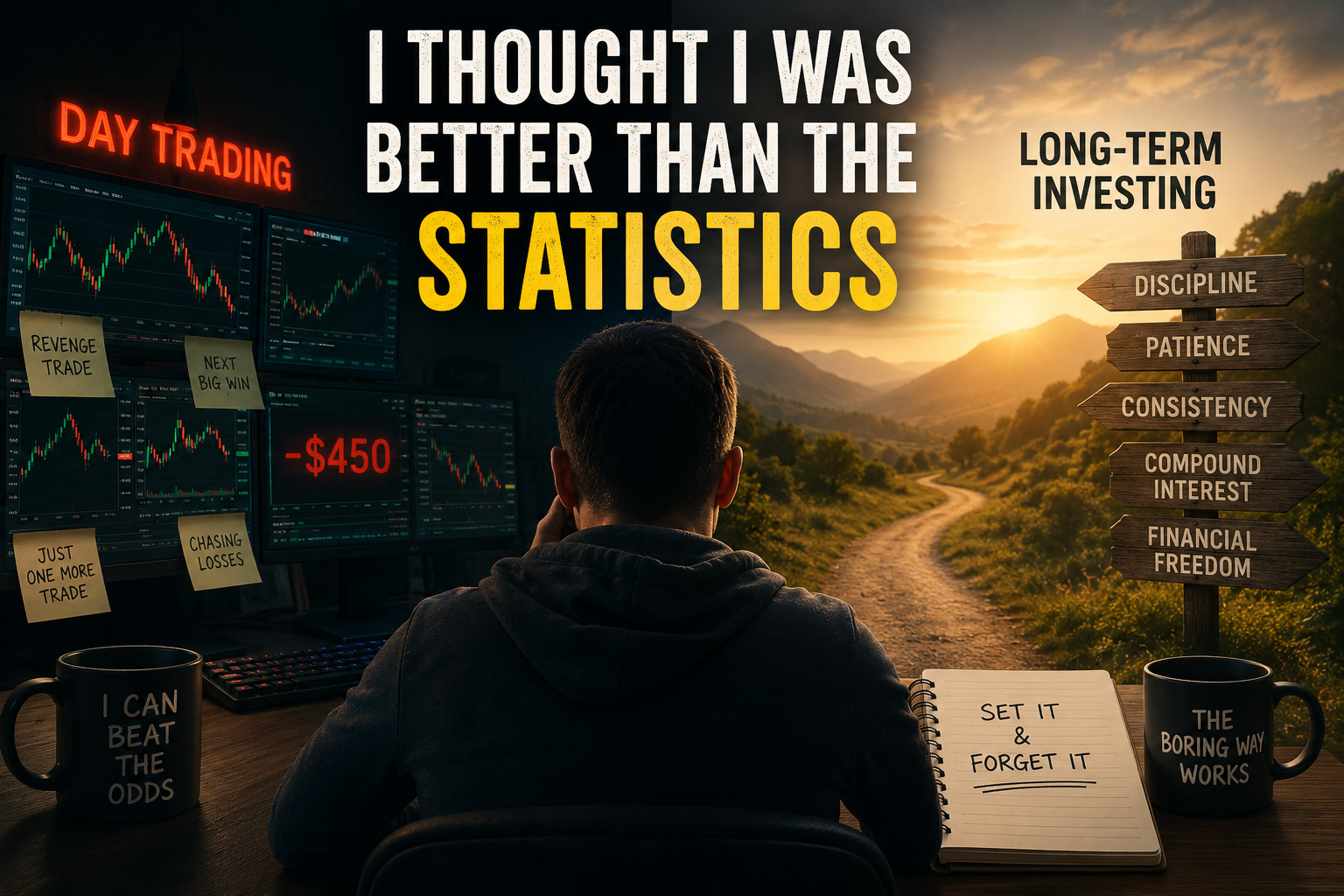
By the end of the day, I had lost nearly $450.
In just one day, I had given back almost everything I had made the day before.
Looking back, I realize I had very little skill.
I was simply incredibly lucky.
At the time, though, I always had an excuse.
“My stop loss was too tight.”
“The volume wasn’t there.”
“My timing was off.”
“It was still the right stock.”
Anything but admitting that I simply wasn’t good at day trading.
The Real Cost Wasn’t the Money
Ironically, my early wins were enough to offset many of my later losses.
When everything was said and done, I ended up losing around $500.
Thankfully, that wasn’t a disastrous amount of money.
But it still stings knowing I lost it because I believed I would be part of the 5% who consistently make money day trading.
The money wasn’t the biggest loss, though.
The real cost was the time and energy.
I spent countless hours reading day trading books, watching YouTube videos, studying charts, and listening to podcasts.
I became obsessed.
My wife, who was my girlfriend at the time, even told me I was becoming ridiculous.
I brushed her off and told her this was going to be my new thing.
Looking back, I should have listened.
It would have saved me money, time, and a tremendous amount of mental energy.
I Wasn’t Better Than the Statistics
After only a few weeks, I finally accepted reality.
I was down $500 and had nothing to show for it except stress and frustration.
So I pulled the plug.
I finally admitted that I was part of the 95%.
That was a difficult pill to swallow.
I had built this narrative in my head that I would be different.
That I would be one of the few who made it.
Admitting defeat meant admitting I wasn’t special.
I wasn’t the next great day trader.
I was average.
If you put me in a room with 100 day traders, I would blend in with the other 95 who lost money.
No one enjoys admitting they’re wrong.
But sometimes it’s one of the healthiest things you can do.
And that became one of the greatest financial lessons I’ve ever learned.
The Lesson That Changed Everything
The lesson wasn’t about picking the right stock.
It wasn’t about finding a better strategy.
It wasn’t even about losing money.
The lesson was learning that admitting defeat can actually move you forward.
Admitting you’re wrong can save your future.
It can redirect your time, money, and energy toward something that actually works.
Once I admitted I wasn’t a good day trader, I looked at my other investments.
The answer became obvious.
My 401(k), which had been quietly dollar-cost averaging into mutual funds for years, was doing incredibly well.
Meanwhile, my individual stock picks and day trades were consistently underperforming.
So I made a decision.
I stopped trying to outsmart the market.
I shifted my investing strategy almost entirely to low-cost mutual funds and continued dollar-cost averaging every paycheck.
Today, I rarely check my portfolio.
I don’t watch stock charts.
I don’t chase the latest hot stock.
For all intents and purposes, I’ve adopted a “set it and forget it” investing strategy.
I might check my account once a month just to see the balance, but I don’t tinker with it.
And the best part?
It’s working better than I ever imagined.
No, I’m not a multimillionaire in my 30s.
But I’m building wealth consistently, sleeping better at night, and statistically doing far better than many people my age.
I’ve realized that I’m much better at building wealth the slow, boring way than trying to get rich overnight.
Final Thoughts
I thought I was the exception to the statistics.
It cost me in more ways than one.
I believed I was smarter, more disciplined, and more skilled than the average person.
Sometimes we are exceptional.
But more often than we’d like to admit, we’re average.
And that’s okay.
When you come across a statistic that is overwhelmingly stacked against success, don’t ignore it just because you think you’ll be the exception.
Study it.
Understand why it exists.
Respect it.
Because becoming the exception is incredibly rare.
I certainly wish I had.
Leave a Reply